
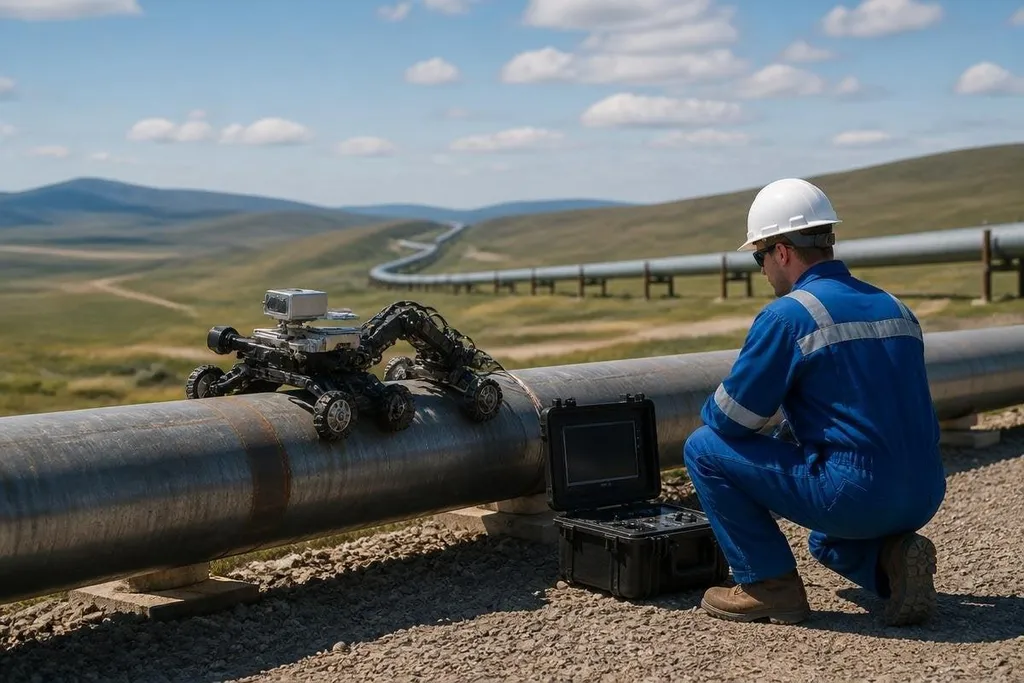
A pipeline can run for many kilometers, pass under roads, and carry material people can’t safely approach. Robots give inspection teams a way to check the inside or outside of that infrastructure while the line stays in service, where the design allows it.
- Robots can carry cameras and sensors into narrow pipe sections.
- Magnetic crawlers can hold to steel surfaces during checks.
- Inspection data helps teams plan repairs before a small fault grows.
The job pipeline robots handle
Pipeline robots are built for inspection, not general work. An internal crawler moves through the pipe and records images, wall thickness, pressure, or shape. An external robot can travel along the pipe’s surface and inspect welds, coatings, valves, and supports.
The robot’s value comes from putting the sensor close to the part that needs checking. A camera can show a crack or blocked section.
An ultrasonic sensor sends sound through the pipe wall and measures the returning signal, which can show metal loss that a normal camera cannot see.
Some systems also use magnetic wheels. The magnets keep the robot attached to a steel pipe as it moves across the outside surface, including sections where a person would need ropes, lifts, or a road closure.
Why the need is growing
Older pipelines do not fail on a neat schedule. Corrosion, damaged coatings, ground movement, pressure changes, and repeated loading can affect different sections at different rates. A fixed inspection plan may miss a new problem between checks.
Robots can make more frequent checks practical when the route, pipe design, and operating rules allow it. That gives an inspection team more data from the same asset, which can help them compare a section with its earlier condition instead of judging it from one visit.
The work also matters where access is hard. A pipeline may cross a steep slope, a flooded area, a busy road, or a site with harmful gas. Remote machines keep people farther from those hazards while still sending back images and sensor readings.
That does not remove the need for trained inspectors. The robot gathers evidence; people decide what the evidence means and what repair work should follow.
The limits are physical
A robot can only inspect the route its body and sensors can reach. Internal systems may need a launch point, a recovery point, enough space around valves, and a pipe interior free from obstacles that could stop the crawler.
The pipe itself also sets the rules. Diameter changes, bends, welds, deposits, flow speed, and pressure can limit movement. An external crawler may need a clean steel surface, while a camera system may lose useful images in dark fluid or heavy deposits.
Data quality is another concern. A long inspection run can create a large set of images and sensor readings. Teams need a clear way to label each reading by location, compare it with earlier records, and send a person back to check uncertain results.
I’d judge a pipeline robot by the inspection record it produces, not by how well it moves in a demonstration.
A pipeline inspection claim needs the pipe diameter, sensor, travel speed, test date, and measured fault. Reports from Robot 24 can put those details beside the robot’s result before you compare systems.
What to check before choosing one
A useful buying decision starts with the pipe and the inspection task. Check these points before discussing robot features:
- Pipe access: Confirm the launch, recovery, and service points.
- Pipe condition: Record diameter, bends, welds, deposits, coating, and flow.
- Sensor need: Decide if the task calls for images, ultrasonic readings, magnetic checks, or several sensor types.
- Data output: Ask how each reading gets tied to a pipe location and stored for later comparison.
- Recovery plan: Set out what happens if the robot loses power, signal, traction, or contact with the pipe.
- Human review: Name the person or team that checks uncertain results and approves follow-up work.
This checklist changes the purchase from a robot search into an inspection plan. It also exposes a common mismatch early: a crawler with the right camera may still be the wrong tool if the real task is measuring wall loss.
Pipeline robots are becoming more important because inspection teams need better access to long, hazardous, and hard-to-reach assets. The next useful measure is plain: can the robot return repeatable data from the pipe sections that people struggle to inspect?